A black and tan dog resting on a blanket

Cancer vaccinesfor dogs.

Gamgee is developing personalized mRNA cancer vaccines from each dog’s own tumor, beginning with an Australian clinical trial for mast cell tumor and osteosarcoma.

See how it works  →

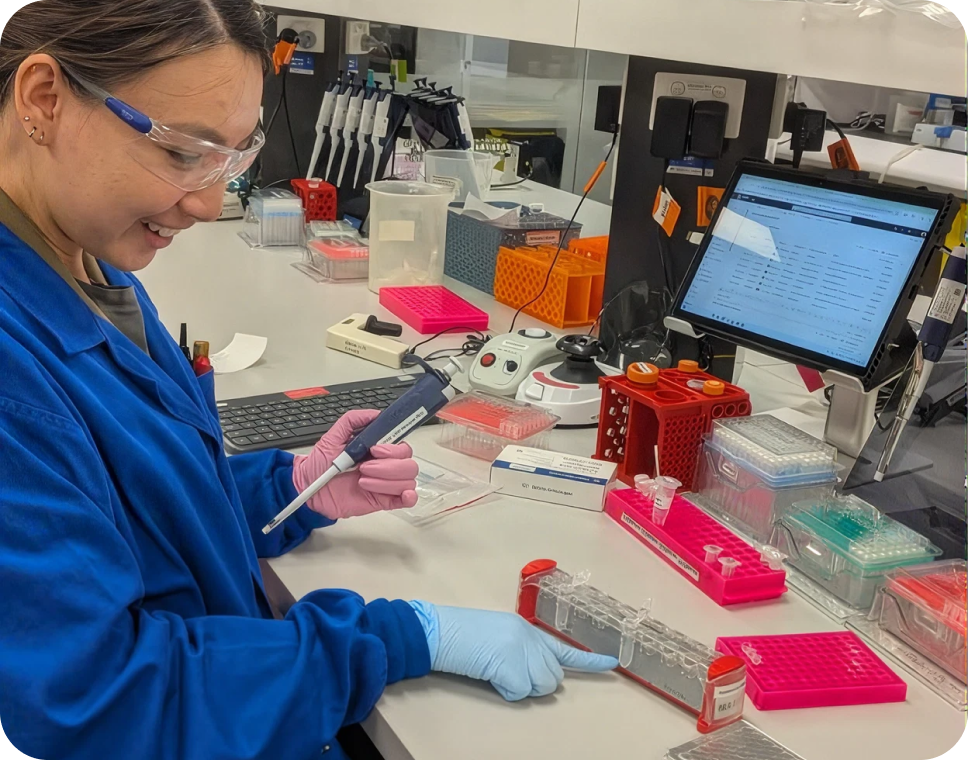
A researcher working with samples at a laboratory bench

What Gamgee is studying

We are studying atherapeutic mRNA vaccinefor dogs with cancer.

Rather than targeting every cancer in the same way, we use each dog’s tumor and matched blood to design a vaccine intended to help the immune system recognize that individual cancer.

The basic idea

From tumor to vaccine.

01Compare tumor and blood
02Find tumor-only mutations
03Rank neoantigen targets
04Design the mRNA vaccine
Start here

Gamgee’s vaccine is designedto treat cancer.

It is a therapeutic cancer vaccine for dogs that already have cancer, not a routine vaccine intended to prevent cancer in healthy dogs.

01 For a dog with cancer

Designed for an existing tumor

Gamgee’s approach starts with tumor tissue and matched blood from one dog. We compare them to identify mutations found in the cancer but not in healthy cells.

Selected mutation-derived targets are encoded into an mRNA vaccine intended to direct an immune response toward that dog’s cancer.

02 Before cancer develops

Preventive cancer vaccines

These aim to reduce the chance of cancer developing in a healthy dog. Broad preventive approaches are being studied, but they are not routine preventive care.

Prevention is not part of our current therapeutic trial. As the platform and evidence develop, Gamgee is exploring how cancer-vaccine technology could expand over time, including its potential role before cancer develops.

Start here

How Gamgee designs a personalizedmRNA cancer vaccine.

The workflow turns information found in one dog’s tumor into a patient-specific mRNA design. Each stage requires laboratory, computational and clinical review.

01

Collect samples

Tumor tissue and a normal sample, usually blood, provide the paired material needed to separate inherited variation from tumor-specific changes.

02

Compare the DNA

Sequencing data is analyzed to identify mutations present in the tumor but not in the dog’s normal sample.

03

Select targets

Candidate neoantigens are assessed and ranked. Prediction is imperfect, so expert review and quality controls matter.

04

Encode the signal

Selected targets are encoded in an mRNA design intended to help antigen-presenting cells teach T cells what to recognize. The design is reviewed before manufacturing, with the selected targets documented for the clinical team.

05

Delivering to the clinic

The finished vaccine is delivered to the treating clinic with a patient-specific dosing schedule.

06

Monitoring outcomes

Clinical and response data are monitored so the trial can evaluate safety and patient outcomes.

This describes the research concept. It does not mean every tumor yields suitable targets, that every dog is eligible, or that an immune response will produce a clinical benefit.

A veterinary researcher working with samples while a dog rests nearby
What Gamgee is studying

How personalized cancer vaccines are evaluated scientifically.

A vaccine design is a biological hypothesis. Sequencing, immune monitoring and clinical outcomes are separate layers of evidence, and each needs to be measured directly.

Biological evidence

  1. Paired tumor and blood sequencing distinguishes acquired tumor mutations from inherited variants.
  2. Candidate neoantigens are ranked by whether a mutated peptide is likely to be produced, presented by canine DLA molecules and recognized by T cells.
  3. Manufacturing and quality controls test whether the intended mRNA construct is produced consistently for the individual patient.
  4. Immune assays can test whether vaccination produces a target-specific cellular response.

Clinical evidence

  1. Safety and tolerability are assessed from adverse events and laboratory monitoring after each dose.
  2. Tumor response requires standardized measurements over time rather than visual impression alone.
  3. Duration of response, progression and survival must be interpreted alongside tumor type, stage and other treatment.
  4. Controlled studies are needed to distinguish a vaccine effect from natural disease variation and concurrent care.
Common questions

Cancer vaccines for dogs, in plain language.

Is there a cancer vaccine for dogs?

Yes, although there is no single vaccine for every type of canine cancer. Gamgee is developing a personalized mRNA cancer vaccine for dogs, created using information from each dog’s own tumor. The approach is currently investigational and is being studied through an Australian clinical trial.

Does a dog cancer vaccine prevent cancer?

Most cancer vaccines for dogs are therapeutic, meaning they are intended for dogs that already have cancer. Gamgee is currently studying this type of vaccine: a personalized mRNA vaccine designed from each dog’s tumor. Preventive cancer vaccines are also being researched, but they are not part of Gamgee’s current trial.

Is an mRNA cancer vaccine available for dogs?

Personalized mRNA cancer vaccines for dogs remain investigational. Gamgee is evaluating its approach through an Australian clinical trial currently limited to mast cell tumor and osteosarcoma. Registration does not guarantee screening, eligibility, enrollment or treatment.

Which cancers is Gamgee’s current trial considering?

The current trial is considering dogs with mast cell tumor or osteosarcoma. Gamgee is not currently accepting other cancer types into this trial, and not every dog with MCT or osteosarcoma will meet the study’s individual selection requirements.

Does a cancer vaccine replace surgery or chemotherapy?

Not generally. Cancer vaccines are commonly studied or used as part of a wider treatment plan. Only the treating veterinary team can advise whether surgery, chemotherapy, radiation, immunotherapy, palliative care or a research study is appropriate for an individual dog.

How much does a cancer vaccine for a dog cost?

There is no single price. Costs depend on the product or study, tumor sampling, sequencing, manufacturing, specialist care, travel and follow-up. If you register interest in Gamgee’s clinical trial, the Gamgee team will explain the study process, potential costs and what may be covered. Registration does not guarantee eligibility, enrollment or treatment.

A dog participating in Gamgee’s Australian clinical trial

Our Australian trial is now considering two cancer types.

We are accepting registrations for dogs with mast cell tumor or osteosarcoma. Every case is reviewed individually, and not every dog with one of these diagnoses will be selected for screening, enrollment or treatment.

The trial is not currently accepting other cancer types. The authorized trial team and treating veterinarian determine potential eligibility. Please continue your dog’s existing veterinary care while your information is reviewed.

View the Australian trial  →